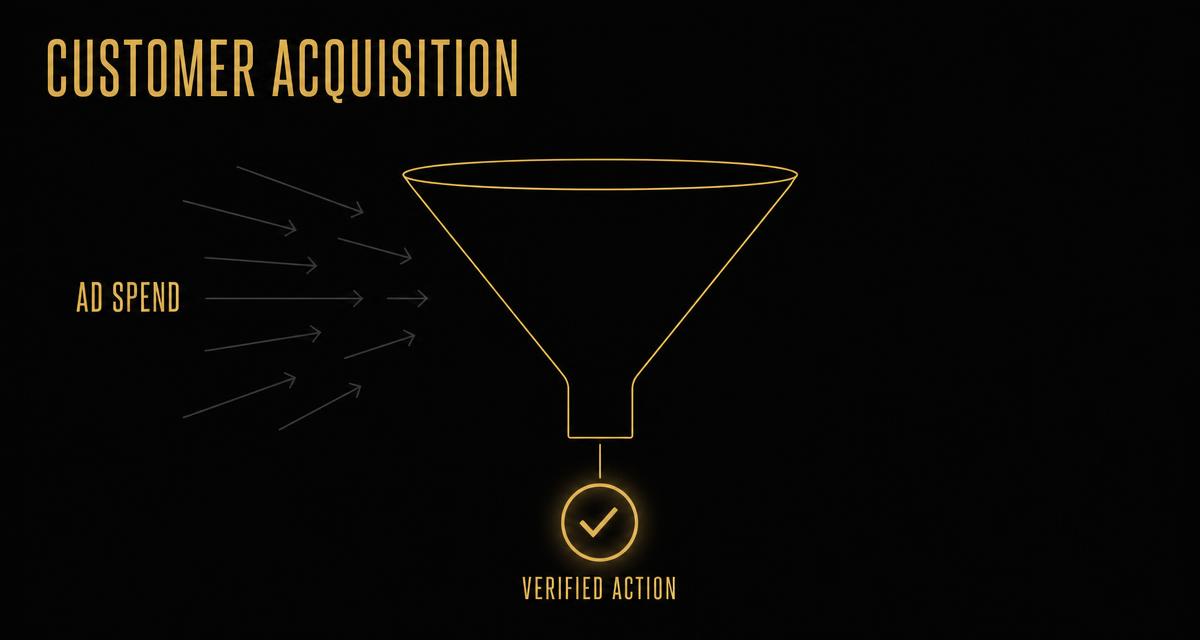
Most customer acquisition advice for small businesses lists the same five tactics: social media, email marketing, SEO, referral programs, and paid ads. All of them can work. None of them guarantee a result — you can run all five and still pay for reach that never turns into a customer. A newer approach, pay-for-verified-action advertising, flips that: you only pay once a customer actually completes and verifies a specific action, like booking an appointment, showing up, or referring a friend.
Here’s a real example of what that looks like: a roofing company dropped off a physical gift card offer to a homeowner. The homeowner activated it and booked an appointment within 20 minutes. No ad spend wasted on impressions, no lead sitting in a CRM going cold — a single verified action, converted almost immediately.
Here’s how the common strategies actually perform, and where a verified-action model like ACE fits in.
The standard customer acquisition strategies (and their real limitation)
- Social media marketing — builds awareness, but converting followers into paying customers takes consistent effort and doesn’t scale predictably.
- Content marketing / SEO — compounds over time, but takes months to show results and requires ongoing production.
- Email marketing — high ROI for existing contacts, but doesn’t solve the problem of acquiring new ones.
- Paid advertising (PPC, social ads) — fast, but you pay for clicks and impressions whether or not they convert. This is the single biggest source of wasted acquisition spend for small businesses. If you’re weighing paid channels, see our 5 alternatives to Google Ads.
- Referral programs — genuinely effective, but most referral programs rely on customers remembering to do it, with no real enforcement or verification that it happened.
The common thread: you’re paying for a chance, not an outcome. That’s the gap a verified-action model closes.
The newer strategy: pay-for-verified-action customer acquisition
This is the model behind ACE. Instead of paying for exposure, a business picks a specific action they want a customer to take and only pays once that action is confirmed:
- Pick the reward — a real gift card (Amazon, Starbucks, Target, Visa, DoorDash).
- Pick the amount — the business sets the value.
- Pick the action — refer a friend, book an appointment, sign up, show up, or watch something.
- Pick the audience — who the offer reaches.
- Pick the delivery method — how the offer is delivered.
- Pick the activation deadline — how long the customer has to act.
The customer knows exactly what they get and exactly what they need to do. ACE verifies the action happened before the reward is funded and the business is charged. No verified action, no cost. The mechanism is protected under U.S. Patent No. 11,847,634 B2, with additional patents pending.
Real example: roofing company books an appointment in 20 minutes
A roofing business used a direct-mail gift card offer through ACE: homeowners received a physical card tied to a specific action — book an inspection appointment. One homeowner activated the offer and booked the appointment within 20 minutes of receiving it.
What made that possible wasn’t a bigger ad budget or a cleverer message — it was that the offer removed the two biggest points of friction in home-services acquisition: uncertainty about cost (“what’s this going to cost me just to find out?”) and lack of urgency (most roofing leads sit for days before anyone follows up). A concrete reward tied to a concrete action collapsed both. The business paid for one verified outcome — a booked appointment — not for the mailer being opened, read, or ignored.
This is what a verified-action strategy looks like in a real, high-consideration service category like roofing, where the sales cycle is normally slow and leads typically go cold fast.
Across ACE campaigns more broadly, offers are seeing a 14% engagement rate — and Amazon gift cards are producing the highest activation rates of any reward option, ahead of other major retail and dining brands. That reward choice matters as much as the offer itself: a reward customers actually want to redeem is what gets an offer opened and acted on in the first place.
Reward choice also depends on context, not just overall activation rate. For business-to-business outreach, Starbucks gift cards perform well because they carry a “coffee on me” framing — it reads less like an incentive and more like a networking gesture, which lowers resistance for a professional audience being asked to take a meeting or a call.
Why this changes customer acquisition cost (CAC)
Customer acquisition cost is normally calculated as total spend divided by customers gained — including all the wasted spend on impressions and clicks that never converted. When you only pay for a verified action:
| Strategy | What drives cost up | What ACE changes |
|---|---|---|
| PPC / social ads | Clicks that don’t convert | No charge unless the action is completed |
| Referral programs | Referrals that are never verified or followed up | Reward and charge only after the referral is confirmed |
| Review requests | Customers who never actually leave a review | Ask for an honest review right after a rewarded action; the review is never rewarded |
This doesn’t replace the other strategies — a strong website, active social presence, and good SEO still matter for making the offer visible in the first place. But it removes the largest source of waste: paying for people who never actually act.
Putting it together: a practical customer acquisition stack
- Foundation — a fast, well-structured website and basic SEO so people can find you at all.
- Awareness — social media and content to stay visible to your audience.
- Acquisition mechanism — a verified-action campaign (like ACE) for the specific outcomes that actually grow the business: reviews, bookings, referrals, sign-ups.
- Retention — email and loyalty touches to keep acquired customers coming back.
The businesses seeing the best results aren’t picking one channel over another — they’re layering visibility (SEO/content/social) with an acquisition mechanism that only costs money when it actually works. For the broader playbook, start with our complete guide to marketing a small business.
Frequently asked questions
What are the best customer acquisition strategies for small businesses?
Social media, SEO, email marketing, referral programs, and paid advertising remain the standard channels. A newer approach — pay-for-verified-action advertising — adds a way to acquire customers where cost is tied directly to a confirmed outcome rather than exposure.
How can a small business reduce customer acquisition cost?
The biggest lever is eliminating spend on outcomes that never happen — clicks that don't convert, referrals that are never followed up, review requests that go ignored. Verified-action models only charge once the specific action is confirmed.
What is pay-for-verified-action advertising?
A marketing model where a business only pays after a customer completes and verifies a specific action, such as booking an appointment or referring a friend. ACE is a platform built around this model.
Do referral programs still work for customer acquisition?
Yes, but traditional referral programs are hard to track and rarely verified. Pairing a referral action with a verified reward — rather than an honor-system discount code — makes the strategy measurable and only costs money when a referral is actually confirmed.
Which gift card reward gets the highest engagement?
Across ACE campaigns, Amazon gift cards see the highest activation rates of any reward option, with offers overall averaging a 14% engagement rate. Reward choice has a direct impact on whether an offer gets opened and acted on.
Does the best reward differ for B2B vs. consumer offers?
Yes. Amazon gift cards perform best for consumer actions overall, but Starbucks gift cards tend to work better for B2B outreach — the “coffee on me” framing feels like a networking gesture rather than an incentive, which lowers resistance from a professional audience.
ACE (Actual Consumer Engagement) is a pay-for-verified-action advertising platform for small businesses. Read the related guide: New Marketing Methods for 2026.