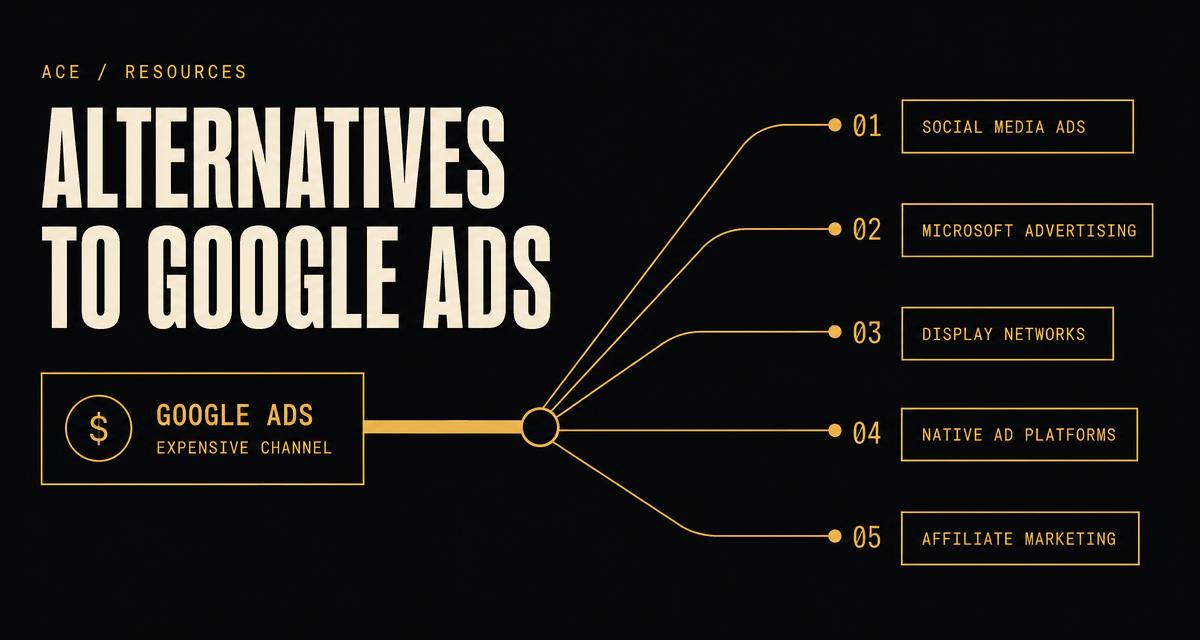
Short answer: the best alternative depends on what you can afford to risk. Meta Ads and SEO still ask you to pay for attention up front. Referrals, direct mail, and pay-per-engagement models let you pay closer to the actual result.
Why businesses look for alternatives to Google Ads
Google Ads works — if you can afford to lose money finding out what works. Click costs in competitive industries routinely run $50–$100+, you get no opt-in, no direct data on who clicked, and no way to know how much of that traffic was even human. For a small business without deep pockets, that’s not marketing — it’s gambling with rent money.
Here are five real alternatives, ranked from “still paying for exposure” to “only paying for results.”
What I’ve seen consulting with clients
I’ve consulted with a lot of clients who are struggling with ads because they think they can just post an ad and get clients. That’s not how it works. You have to be able to tell a story over time.
The average person needs to see an ad at least 8 times, in 8 different ways, before they take the next step. If you’re geo-targeting a local area, that’s manageable. But if you have a national audience, hitting that frequency is almost impossible to do for under $50,000 a month in ad spend — and once you add a creative team and an ad-buying team on top of that, your real cost climbs to around $60,000 a month.
That’s the gap most small businesses fall into: they can’t afford the frequency it actually takes to convert a stranger into a customer, so they run a few ads, don’t see results, and conclude “ads don’t work.” Ads work. Most businesses just can’t afford to run them the way they need to be run.
1. Meta Ads (Facebook & Instagram)
Meta Ads are still pay-per-click or pay-per-impression, but targeting tends to be sharper and cheaper than Google for many industries — especially local and lifestyle businesses. You’re still paying regardless of whether someone acts, but costs are often lower and creative testing is faster.
2. SEO and content marketing
Ranking organically means you stop renting attention and start owning it. It’s slower — often 3–6 months before real traffic shows up — but once a page ranks, the traffic is free. This works well alongside a platform like ACE, since well-optimized articles can also serve as the landing pages your ad-driven traffic converts on.
3. Referral and affiliate programs
Instead of paying a platform for a stranger’s click, you pay your own customers (or partners) for a warm introduction. Referral traffic converts higher than almost any paid channel because it comes with built-in trust.
4. Direct mail and SMS outreach
Unfashionable, but underused — which is exactly why it still works. Direct mail and SMS let you reach a specific list of real people directly, without an algorithm or auction deciding who sees your message.
5. ACE — pay only when someone actually engages
This is the one we built. ACE (Actual Consumer Engagement) flips the ad-spend model entirely: instead of paying a platform for exposure, you send a gift card that only gets funded once the recipient completes a specific action — watching a video, opting in, taking a survey, booking an appointment. You can reach people through direct mail, email, SMS, or in person, and you control the spend — send one gift card or a million, but you only pay for the ones that activate. Everyone who engages opts in with their information, so even if they’re not ready to buy today, they’re in your funnel for when they are.
Which alternative is right for you?
If you have the budget to test and iterate, Meta Ads are a reasonable starting point. If you’re playing the long game, SEO compounds. If you already have happy customers, a referral program is close to free. But if you want to stop paying for clicks that might not even be real people — and only pay when someone verifiably engages — that’s exactly the gap ACE was built to close.
More reading: Small Business Advertising Is Broken and Marketing for Small Businesses: The Complete Guide.
Common questions
Why are Google Ads clicks so expensive?
In competitive industries a single click routinely runs $50 to $100 or more. You pay for the click whether or not the person opts in, you get no direct data on who clicked, and no reliable way to know how much of that traffic was even human.
What is the cheapest alternative to Google Ads?
SEO and referral programs cost the least over time. SEO is slow — often three to six months before real traffic shows up — but once a page ranks the traffic is free. A referral program pays your own customers instead of a platform, and referred traffic converts higher than almost any paid channel.
How much ad spend does it take for ads to work?
The average person needs to see an ad about eight times, in eight different ways, before taking the next step. Locally that is manageable. Nationally, that frequency is hard to hit under $50,000 a month in spend — closer to $60,000 once you add a creative team and an ad-buying team.
What does pay-per-engagement advertising mean?
Instead of paying a platform for exposure, you send a gift card that only gets funded once the recipient completes a specific action — watching a video, opting in, taking a survey, booking an appointment. You pay for completed actions, not clicks or impressions.