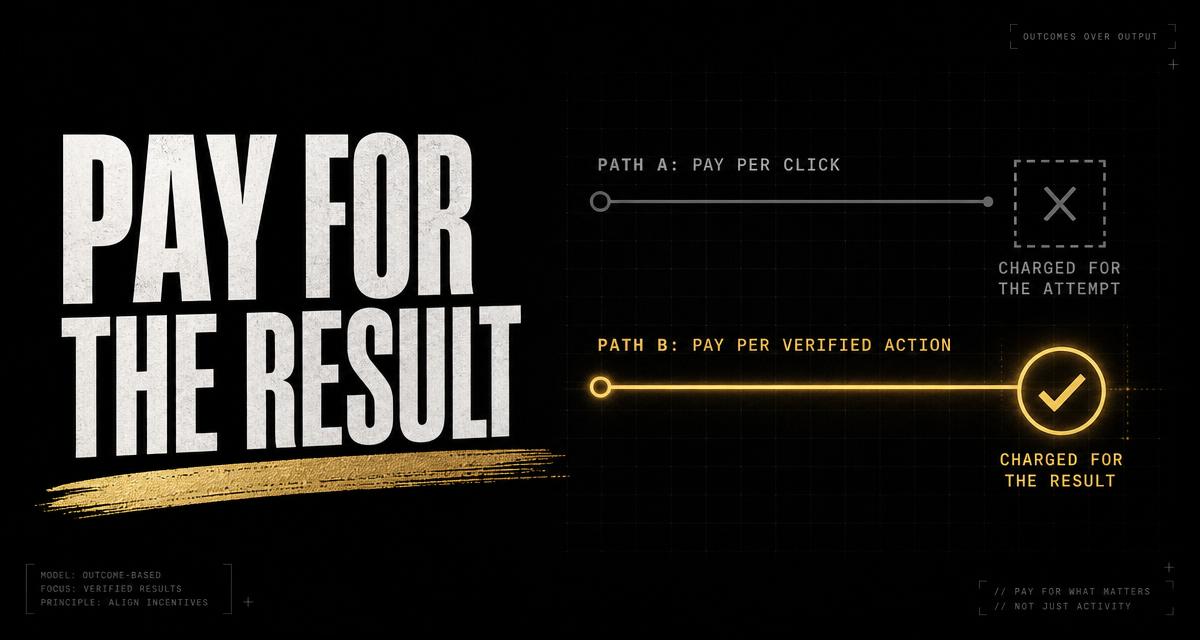
Think about what you actually bought the last time you ran ads.
You didn’t buy customers. You bought impressions, or clicks, or a lead that three of your competitors bought at the same moment. The money left your account before anyone did anything, and you found out weeks later whether it worked.
That’s the deal every major ad platform offers: you pay for the attempt, and you discover the outcome afterward. It’s so normal that most business owners have stopped noticing it’s strange. For the wider picture on where ad spend fits alongside referrals, reviews, and direct mail, see our complete guide to marketing a small business.
But it’s worth sitting with the question. What would it change about your business if you only paid when something actually happened?
What does “only pay for results” actually mean?
It means the charge fires on a completed action, not on exposure.
The distinction matters because “results-based advertising” gets claimed by almost everyone, including platforms that just mean “we optimize toward conversions.” Optimizing toward a result and billing on a result are completely different things. One is a targeting strategy. The other changes who carries the risk.
In a genuine pay-per-result model, if nothing happens, you’re not charged. Not a smaller amount. Nothing.
What counts as a result?
This is where most “pay for performance” offers get slippery, so it’s worth being specific. A result should be a discrete action you’d recognize as valuable if you watched it happen. At ACE, the business picks the action before the campaign runs, from a defined list:
- Someone watches your video, start to finish
- Someone books a consultation or appointment
- Someone attends the appointment they booked
- Someone leaves a review
- Someone refers another person who opts in
- Someone makes a purchase
Notice what’s not on that list: a click, an impression, a form fill from someone who filled out four other forms that afternoon, or a “lead” that’s really just contact information. Those are attempts wearing a result’s clothing.
Picking the action up front also forces a useful conversation. Most businesses running ads have never actually specified what they want a stranger to do. “More customers” isn’t an action. “Attend a design consultation” is.
How can a business afford to pay only on results?
Here’s the part people get stuck on, and it’s a fair question — if the advertiser doesn’t pay unless it works, who’s fronting the cost?
The answer is that the money moves in a different direction than you’re used to.
In traditional advertising, your budget goes to a platform in exchange for access to an audience. Google, Meta, and the lead marketplaces sit in the middle and capture the value created by a consumer’s attention. The consumer — whose attention is the entire product being sold — gets nothing.
ACE routes that spend to the person instead. The business attaches a real gift card to the action they want. The consumer sees a genuine offer: do this specific thing, get something real. If they do it, the reward funds and delivers at that moment, and the business is billed for that engagement. If they don’t, the reward is never purchased and the business isn’t charged.
That last part is the mechanism, not a policy. Unclaimed rewards don’t get funded, so there’s no pool of wasted spend to reconcile later. Waste is capped by how the system is built.
What stops people from gaming it?
Verification — and this is the piece that makes the model work rather than just sound good.
Before any reward releases, the action has to be confirmed as actually completed. A watched video is verified as watched. A booked appointment is verified as booked. Nothing pays out on a promise or a self-reported click, which is precisely the soft spot that quietly inflates costs in click-based advertising.
The conditional-unlock mechanism at the center of this is covered by U.S. Patent 11,847,634 B2 — Systems and Methods for Conditionally Gifting Funds. That’s the technical core: funds that exist but don’t move until a condition is genuinely met.
How does the math compare to what you’re paying now?
Take home services, where the numbers are well documented.
Angi’s cost per booked job runs around $542. Roughly 75% of pay-per-lead contacts go silent after first contact — and the contractor pays anyway, because the charge fired when the lead was delivered, not when the customer answered. Those same leads are typically sold to several contractors at once, so you’re often paying for the privilege of competing.
By comparison, a named, opted-in prospect through ACE runs roughly $70 all-in — the engagement fee plus the gift funding the business chose. That comparison is context, not a promise; every business and vertical is different. But the structural difference is the point: in one model you’re paying for a maybe that three competitors also bought, and in the other you’re paying for something that already happened.
Where this fits best
Pay-per-result advertising isn’t universally better. It fits best where one new customer is worth enough to justify a real incentive:
- Home services — roofing, pools, HVAC, remodeling
- Healthcare and specialty clinics
- Professional services
- Auto
- Restaurants with strong repeat value
It also matters disproportionately for businesses locked out of the major ad platforms entirely — hormone therapy, cannabis, firearms, crypto — where Google and Meta aren’t an option regardless of budget. For those businesses, this isn’t a better channel. It’s often the only compliant one.
It fits worst where the margin per customer is thin. If a new customer is worth $15, there’s no room for a meaningful reward, and traditional volume-based advertising is a better tool.
The honest version
Most advertising asks you to buy a probability and hope. That’s not a scam — it’s just an old arrangement that stuck around because nobody had a practical way to verify individual actions at scale.
There is one now. Which means the interesting question isn’t whether pay-per-result advertising works. It’s why you’re still paying for the attempt.
See what this would look like for your business
ACE is a pay-for-verified-action advertising platform. You choose the action, the audience, the reward, and the channel — mail, email, text, QR, or in person. The reward funds only when the action is verified, and unclaimed offers are never purchased.
Want the broader playbook first? Start with our complete guide to marketing a small business — it covers strategy, channels, budget, reviews, referrals, and how to measure what’s actually working. If you’re comparing paid channels, read 5 Alternatives to Google Ads.
Common questions
What is pay-per-result advertising?
Pay-per-result advertising is a model where a business is charged only when a specific, verified action is completed — such as a watched video, a booked appointment, or a completed purchase. Impressions and clicks are not billable events.
How is this different from pay-per-click?
With pay-per-click, you're charged the moment someone clicks, regardless of what happens next. A click that goes nowhere still costs you money. With pay-per-result, the click is free and you only pay when the action you actually wanted is completed and verified.
Isn't this the same as buying leads?
No. Lead marketplaces charge when contact information is delivered, and often sell the same lead to several businesses at once. Pay-per-result billing fires on a completed action from a person who chose to engage with your offer specifically.
What happens if nobody responds to the campaign?
Nothing is charged. Rewards that go unclaimed are never purchased, so an offer that doesn't land costs the business nothing beyond the campaign setup.
Is a bigger reward more effective?
Usually, up to a point — but the right number depends on what a customer is worth to you. A business with a $50,000 average sale can justify a far larger incentive than one with a $200 sale, which is why this model fits high-ticket businesses best.